
A behind-the-scenes look at why AI will likely take over the creative industries, using the writing industry as an example, whether people like it or not.
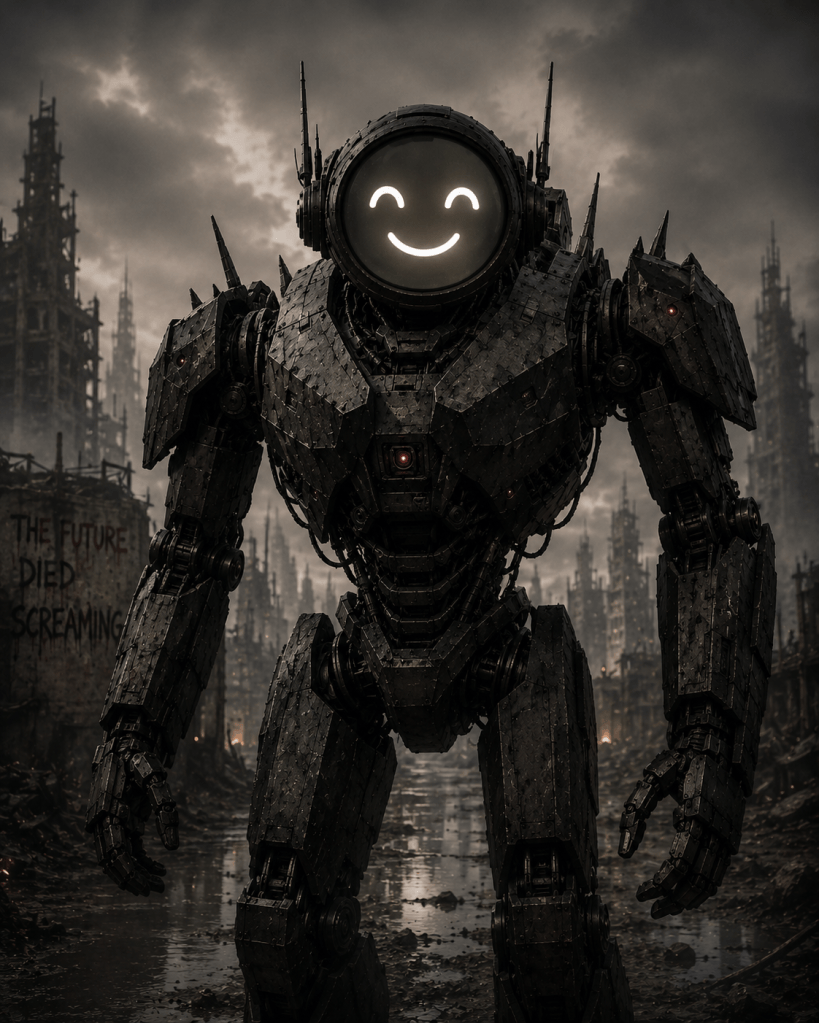
By 2050, if things continue to progress as they are, I suspect that painting illustrations, writing books, making music, and voice narration, probably video games, not to mention a significant portion of the film industry, will all be dominated by AI. This outcome is already happening now, and is only exacerbated by a weak education system and too many elderly congressmen and women who have absolutely zero idea how to react to AI.
I recently made a post on my Facebook page comparing a drawing I made years ago and ran through GPT to “upgrade” it. The post blew up overnight, earning over 130,000 views and almost 2,000 comments, many by angry people who insisted my pencil drawing was better and that because I am a writer who has used AI covers, I must use AI to write my books as well. This is patently untrue, not to mention a false equivalency, but that’s not the point here. Currently, “AI slop” as so many love to call it is pretty easy to spot, most of the time. The thing to keep in mind is that AI is still a technological infant. Anyone born in 1980 or earlier can recall how fast computer technology improved between the mid-’80s to present day. AI is no different. The first “modern” AI, in my opinion, should start in 2011 with Apple’s Siri. Fast-forward to 2020 and Chat GPT-3 was released. I personally first began playing around with GPT in 2024 and have already seen a remarkable improvement just in the past two years. With a little work, competent AI creators are already producing art, music, and videos on par with human professionals. Imagine what will be possible with AI ten years from now, or twenty.
You can make an argument that people doing this aren’t actually “creating” anything, you can argue that AI products are “theft”. Much of these arguments are semantic, and from what I have observed at least, the people who are most vehemently anti-AI seem to be the same group of people who know the least about how AI works. Growing up in the 80’s and 90’s, I saw this same phenomenon occur around video/computer games, where the group of people who were most staunchly against what they were supposedly doing to American youth tended to be older women– the exact same demographic who had the least knowledge or first-hand experience with video and computer games. Love it or hate it, I can’t envision a world where AI does not dominate creative spaces by 2050.
I’m going to focus on the writing community here, as that’s the one that impacts me the most as a mostly-independent author. In a 2022 survey of Public Participation in the Arts and published by the National Endowment of the Arts, 53% of adults (131 million people) in the U.S. read from a book on a monthly basis. 52% created or performed some form of art. This number dropped 6% between 2017 to 2022. A 2025 article from the Smithsonian shows that as of 2023, a mere 16% of Americans read for pleasure on any given day. This is down 40% from just twenty years ago. All of this suggests that the number of people in the U.S. who read for pleasure is plummeting, but the number of people who create art is roughly equivalent to the number of people who engage in it. I translate this as, essentially, both groups of people are in fact the same community, with an increasing amount of overlap as the number of creators and consumers shrink.
Now let me show you the statistics of how well books sell generally. Just looking at books sold from the top ten publishing companies, an article from Current, published in 2024 shows that the largest bracket, 51.4% of their books, sold between just 12 – 999 copies over a twelve month period. To contrast that, .4% sold over 100,000 copies, and 14.7% sold less than twelve copies. I couldn’t find data to show how this compares to self-published authors, but it’s a safe bet that the numbers are much lower. And this is where I want to focus. I found one source that claims that roughly 77% of the surveyed authors are self-published, 17% are hybrid authors who have books published with a traditional company (such as myself) as well as some independently published works, and only 5% are traditionally published. The largest percent of these authors, 56%, make over $100 a month from writing, with 8% making over $10,000 a month.
To contrast these numbers, a novel of say, 100,000 words will generally cost about $1,000 for basic editing- it can easily cost more if the novel is being edited for development, grammar, structure, etc. Then comes the cover. Different genres have different expectations. Some genres can get away with some abstract, graphic designs that might only cost $100, or they could be biographies that only need an attractive image of the subject, which could also be done cheaply. Fiction however, tends to have a different style- especially science fiction, fantasy, or historical fiction. Anyone who peruses these sections can expect to see beautifully done, eye-catching illustrations crammed full of detail that signals to the reader what they can expect within that book. Covers like these simply cannot be done cheaply, at least not by a human. These types of covers, on average, will cost a self-published author about $1,000. Want the book available on Audible? A good, professional narrator will cost yet another $1,000, again on average. Maybe the author can get lucky and find an artist or narrator who will offer a discount because he/she is feeling charitable, or the author can record the book themselves. Some authors do manage to pull that off, but not most. This means that any given book will cost an author between $2 – $4,000 to publish. This has been my experience while pricing services, as well as from talking with other authors and people within this industry. Oh, this doesn’t factor in marketing costs, which are also essential for a book to have any chance of ever being noticed. When a $15 book sells on Amazon, if I’ve agreed to publish only through them, I split that money almost 50/50 with Amazon, so I make about $8 per book. I make about $4 per book if it’s one I’ve published with a company, because the publisher needs their cut as well. The best way I have to make money from my books is to order physical copies (my books cost about $6 each to produce on Amazon Publishing and have them shipped to me) and sell them myself at events. If I do that, and sell them for $20 each, I can walk away with about $10 in profit. Sold that way, this all means that I would need to sell 200+ copies of a book before I’ve even broken even– just on my costs alone. This of course doesn’t factor in the hours I’ve put in, over several months, in actually writing that book. Oh, and then events that let me set up a booth usually cost at least $100 for a small space. So even while I’m trying to sell my books, I’m continuing to generate costs. Per the previously mentioned statistics, that means if I’m lucky, a book will break even within a year or two after I’ve written it.
Now let me contrast that with what happens when I use AI. As AI becomes smarter, editing can be done through AI rather than with a conventional editor. I can create a cover that looks as good to a casual observer as those done by professional artists. Both of these services can be done for the cost of a month’s subscription, say $30. $30 versus $3,000. Three or four books sold to break even instead of three hundred.
There are other factors involved, as well. A human artist likely has a queue of other customers, so getting that cover art might take 2 – 4 months. And what happens if that artist doesn’t produce the illustration quite the way you want it to look (I’ve had this happen, by the way). Now you’re looking at another month or two, on top of the artist possibly trying to get more money for the extra work. I can produce a whole series of images on AI in a few minutes. Minutes versus months. The same is true for the editing process. A fast editor might have a turnaround time of one to three weeks. AI can complete that task in minutes. The same is true of using AI voice narration over a human. In short, the strongest argument for using a human artist, or a human editor or a narrator is the “ethical” argument. In terms of time and money saved, AI is the clear winner. It’s like comparing a horse-pulled cart to a commercial airplane.
I have seen the argument that if I as an author am willing to use AI, even just to produce a cover, why shouldn’t they, as readers, use AI to draft a tailor-made story? My answer to that is within twenty years, they will. As things stand, and AI continues to evolve, artists, writers, singers, etc will still exist, but we will have to do so as a hobby. Only the top 1% will likely be able to do so professionally. This has always happened throughout history whenever a new technology comes along. Once, shoes were made by hand. Clothes were woven and dyed by hand. All art, whether it was a family member’s portrait or a fanciful scenic view, was done by hand. Books were hand-written. Then machinery came along to do much of that labor. Cameras were invented, and the printing press. Some of those professions died out entirely, others still exist, but only as a novelty. So no, AI will never erase artists, writers, and other artists, but it will likely make them obsolete in a professional capacity. I may continue to write, but it will be for the love of writing and the desire to put my thoughts out there for others to enjoy, should they want to, but I am not entitled to anybody’s money, and I fully expect a day to come when only a small fraction of the absolute best writers in the world are able to make any money at it. The same thing is and will continue to happen with the movie, music, and video game industries as well, as more and more people are capable of making professional-grade content from the convenience of their home, for a fraction of the cost that these forms of media have cost in the past.
Literacy rates and quality in the U.S. continue to decline as well. This will also continue to affect the ability of writers to make money. Even if AI never proves capable of matching a human’s ability, it won’t matter that much because most people’s reading skills won’t be sufficient enough to tell the difference between good and mediocre writing. By extension, I believe this will happen with every other form of artistic expression as well. The only path I see to prevent this outcome is if governments step in and enforce severe restrictions on the use and distribution of AI.
As for me, personally, I both love AI and detest it. I hate seeing AI being used in classrooms at every level, even college. Some teachers write lessons and don’t proofread over them well enough, creating incoherent or impossable tasks for their students (my classmates and I had this problem with a professor only a year ago). Students who know their lessons are made by AI use it to complete their work, which is then graded with AI. I hate seeing how news on the internet is outright fabricated with AI-made videos and images. Though this may surprise some, I’m not even especially happy at finding AI necessary in some aspects to produce a professional product out of my novels, and where possible, I absolutely prefer to work with people, on principle. But if and when I find myself forced to choose to either not publish a book at all, or publish it with the use of AI, I will publish. After all, an unpublished manuscript makes no money. With no money I cannot hire future artists, editors, and narrators on future products. As I make money however, I can always begin hiring people, and even use human artists to go back through previous works that originally contained AI elements.
If you made it to the end of this article, you have my appreciation, and respect. It was long, and probably tedious in places. If any part of this article offended you, I won’t apologize for that, as I spoke the truth as I see it. I will however say that offending anyone was not my intention here.
Note: this article was written without the use of AI, though AI was used to help find articles, and to proof for grammatical mistakes.


Leave a Reply