Throughout the novels I’ve written so far, and in all future novels related to my Arthurian series, every moment of my story is set in the real world. I literally write with Google Earth open in a separate window and keep track of where the action of any given scene is taking place at any given time. As to how I select where to place the action, well, that’s the trick. There’s locations all up and down Great Britain associated with the legend of “King” Arthur, either via folklore, or direct naming. Unfortunately, those all seemed to have occurred after Geoffrey of Monmouth made him famous in his 12th century manuscript. So where to start?
First off, I concluded that when looking many of the names associated with Arthur, to include his, they largely seem to be Welsh in origin- except maybe Kay/Cai, which is probably a Brythonic variant of the Latin name Gaius/Caius. Tristan might have begun as Drystan, which is more of a northern name. That said, I don’t think it’s a coincidence that the two earliest “historical” sources we have on Arthur both come from Welsh writers- namely Nennius and Geoffrey of Monmouth. Neither Gildas nor Bede mention Arthur, nor does the Anglo-Saxon Chronicle. This also suggests, to me at least, that Arthur’s story begins as a simple, Welsh, military commander. Indeed, Nennius, the earliest source to reference Arthur, only confers the title of “Dux Bellorum” to Arthur, not king. Dux Bellorum, as it happens, is a Latin title that means “Duke of Battles”. From my research, it’s comparable to a task force commander in modern military ranking. Finally, it makes sense to me that a man famous for his staunch resistance against the Saxons would be Welsh. The Romans weren’t able to truly conquer that region even after being in Britain for 300 years. The Saxons weren’t able to conquer Wales after being in Britain for over 700 years. It took the Normans over 200 years to finally conquer the region, and that only after they built literally hundreds of keeps and castles to deal with the Welsh.
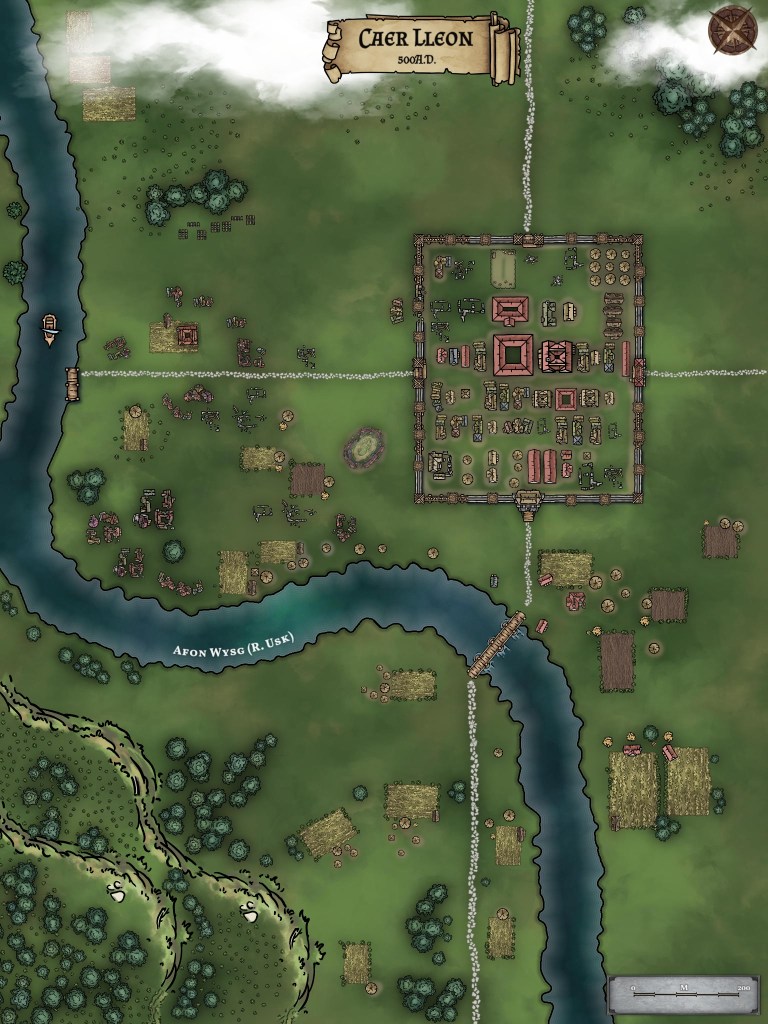
So if Arthur was not a king, and only a military commander in the region of modern day Wales, where might his base have been? At least as early as Geoffrey of Monmouth’s 12th century manuscript, he puts Arthur’s capitol at Caerleon. Later, the French writer Chretien de Troyes attributes his capitol at Camelot. Well, Caerleon was a massive Roman legionary fort, in Wales. Specifically, it’s near the southeastern border of Wales- a good location for a base of operations to fight against Saxons who were invading from southeast England. True, the fort was largely abandoned by the Romans in around 300 A.D., but people most likely continued to live there. So for my purposes, Caerleon was as good a place as any to establish Arthur’s headquarters at. Finally, I decided to also use Tintagel, in Cornwall, as Arthur’s birthplace because, again, it’s how Geoffrey of Monmouth portrayed events (and most writers since then) and it seemed reasonable.
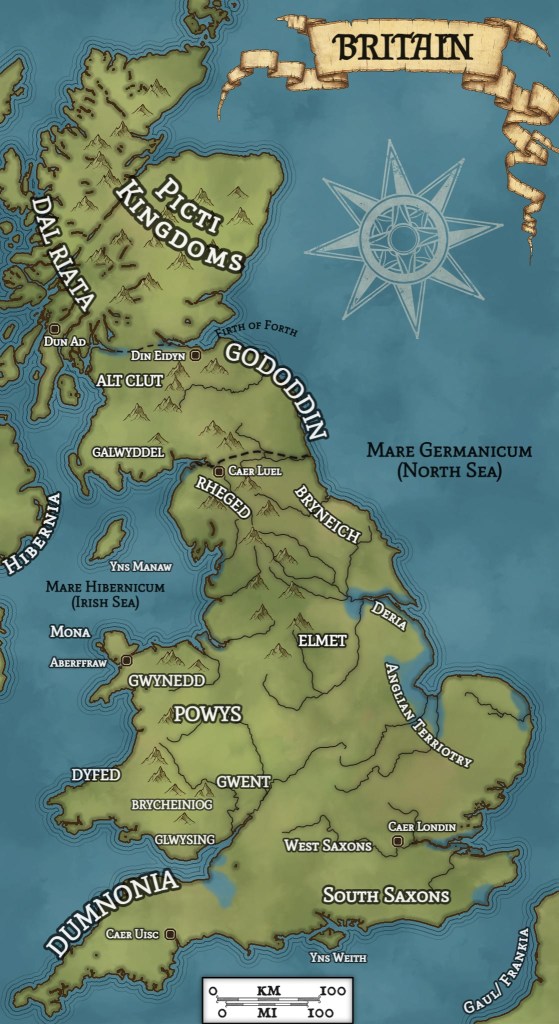
Next came the tricky part- nailing down the location of Arthur’s famous twelve battles, as listed by Nennius. Battle #1 was at the River Glein. As it happens, there’s a couple River Glens in England, one in the north, up by York, and another in central England, near Lincoln. This river would likely have been in Anglian territory. Battles #2 – 5, interestingly, all occur at the same location; the River Douglas, in Linnius. Douglass, or Dubglass, essentially means “black water”. There’s no known river of this name, or with a similar meaning. Some scholars believe that Linnius is Lindsey. So maybe there was a small tributary in that area that’s dried up in the past 1,500 years. This river would also have been in Anglian territory. I found this interesting because first, the fact that battles #2, 3, 4, and 5 all occur at the same site suggest a campaign to me, rather than a group of separate battles. I would further speculate that if a campaign required four distinct engagements, that could mean, despite Nennius’s claim that Arthur was the victor of all twelve battles, maybe battles #2, 3, and 4 were not quite that successful after all.
Battle #6 is at the River Bassus. This one is a true wild card. Noone seems to know what “Bassus” means, and there’s no modern equivalent name. So I actually have the freedom to put this river pretty much wherever I want. That being said, the eastern coastline of Britain has changed a lot since the Dark Age period, especially in the area of the mouth of the rivers Nene and the Great Ouse. Specifically, terrain that was likely underwater is habitable farmland that was drained away during the reign of Queen Elizabeth. So that region seems to be a likely location for a river that no longer exists. Conveniently, that area was also Anglian territory.
Battle #7 was at “Cat Coit Celidon”. There’s a couple theories on this one, but the most common one is that it’s a reference to the woodlands of southern Scotland. Picts were actively raiding the northern half of Britain, as well as the eastern coastland of Britain during the early Dark Age period, so that seemed like a reasonable location to use.
Battle #8 was at “Guinnion Fort”. Like Bassus, this one confounds historians. “Guinn/Gwen” likely means white, in Brythonic, though nobody seems to have any idea what the suffix “ion” could refer to. Historians have mostly interpreted Guinnion Fort to mean “White Fort”. Since none of my betters have come up with a solid explanation, I decided to take a different approach with this one. We know that “Guin” is used in names- like the famous Guinevere/Gwenhwyfar, so I figured maybe Guinnion could be the name of a person, ie: Guinnion’s Fort. If you’ve read Beyond the Wall already, you can see how I made use of this theory. Here again, I had total liberty in choosing where Guinnion’s Fort would be. Since I decided to pair Celidon Coit with Guinnion’s Fort, I eventually decided to use a fort along the Antonine Wall, specifically Castlecary, as Guinnion’s Fort.
Battle #9 is the City of the Legion. This one is really fascinating because, unlike most of the other battles, this one is tantalizingly specific. There are two cities that at one time, literally carried this name- Caerleon and Carlisle. A third city however, was also commonly referred to as a “City of the Legion”, and that’s Chester. Well, in my mind, Caerleon didn’t really work primarily because of its location. It’s too far east to be an easy target for the Saxons or Angles, too far west to be an easy target for the Scoti (Irish), and too far south for the Picts. That leaves Carlisle and Chester. Of the two, both would have been within relatively easy striking distance of the Scoti. Carlisle would have even been a potential target for the Picts, but ultimately, Chester is further south, and closer to Caerleon, making it easier for Arthur to take his men to, so that’s why I choose Chester as the location for Arthur’s 9th battle.
Battle #10 is the River Tribruit. Yep, another river battle. Early in my research, I actually thought Arthur might have been deliberately choosing to fight along rivers, given how many of his battles occur at them. As I became more familiar with Britain’s landscape however, I think that’s still possible, but its just as likely a coincidence. There are just so many rivers in Britain. Interestingly, I’ve come across a few historians who suggest that the battle at the Tribruit is also a battle referenced in Welsh legends, called the Tryfrwyd. They both imply a river crossing site. The common site proposed for this battlefield leans toward the Firth of Forth, possibly around Stirling. That location worked for me, especially as it pairs well with the suspected location of Battle #11…
Battle #11 is at Mount Agned. As always, there’s a few suspected sites for this one. The one I liked most is Arthur’s Seat- a massive hill a few miles south of Edinburgh. It’s close to where the Tribruit could have been, and since I like the idea of minimizing the number of times Arthur travels up and down Britain fighting various foes, as with Celidon Coit & Guinnion Fort, the battles at the Tribruit and Agned could have been fought in a single campaign, maybe against the same enemy. I cover these two battles in my novel, The Wolves of Caledonia, along with the Battle at the City of the Legion.
The last battle Nennius lists is the famous battle at Badon Hill. Not surprisingly if you’ve noticed a trend with the last eleven battles, historians have no real idea where this one was, though most do at least agree that it’s likely a prominent, historical battle. From what I’ve seen in discussions on this battle (and the others, to a lesser degree), where this or that historian theorizes Badon was seems to depend heavily on where that given historians believes Arthur actually came from. Those who believe Arthur was a southern Briton (as I do) tend to look for battlefields that are as south as possible (as I did in choosing Chester instead of Carlisle, for example). Some believe that rather than Welsh, Arthur was in fact a Picti warlord, or at least a northern Briton. Those that do tend to try and find northern battlefields to fit that theory. It is a fair theory- nearly all of Arthur’s battles do lean towards being fought in the region of southern Scotland down to central England. My feeling however is that if this were true, Bede would have more likely mentioned Arthur, given that he was probably a northern Anglo-Saxon. As I said earlier though, it seems like the sources most familiar with Arthur and give him the most mentions were Welsh, so I tend to give Nennius and even Geoffrey of Monmouth, more weight than I think other historians do. To that end, I align myself once again with Geoffrey of Monmouth, who’s manuscript presented Badon Hill as being at Bath. There’s another reason for siding with the Bath-argument as well. Originally, Bath was known by the Romans as Aquae Sulis (Waters of Sulis). I’ve come across a theory that the Britons called the site “Baddon” (in Welsh the ‘dd’ makes a ‘th’ sound) but I haven’t been able to confirm that anywhere. So really, besides Geoffrey of Monmouth’s choice of Bath, the other reason I like this site and find it plausible is that Bath was likely a thriving town even in the 6th century thanks to that hot spring there. It also is right in “No Man’s Land” between the Brythonic kingdoms of modern-day Wales, and Saxon territory.
There are other locations throughout my book that I have used. I use the same methodology for them as I do with pinning down the location of Arthur’s 12 battles. I look for towns that were at the very least, well known to Nennius in his convenient list of prominent towns and cities as of the 9th century- which is the closest source I can get my hands on regarding life in the 6th century. Others, especially in Scotland, I can at least look up online and see how likely it is that they were settled during this period, as well as search up what the were called back then. Many towns have had two or three different names, sometimes at the same time, depending on who’s writing it down. That can be a ‘fun’ mess to sort out.
Anyway, I hope you found this interesting. I’m enough of a history nerd that research like this is genuinely fascinating as hell, for me.
 Kyle's Chronicle
Leave a comment